

Here’s the thing: operational and managerial controls sound like jargon, but they’re actually pretty straightforward once you break them down. Operational controls are the day-to-day execution—the people, processes, and systems doing the work right now. Managerial controls are the policies, frameworks, and oversight that guide that execution. Think of it like this: managerial controls set the rules of the game, and operational controls are how you actually play it.
If you’re managing teams across finance, sales, customer success, or revenue operations, you’re probably dealing with both whether you realize it or not. Understanding the difference helps you build a control structure that actually works instead of one that looks good on paper but falls apart in practice.
What Are Operational Controls?
Operational controls are the hands-on, real-time safeguards and processes your team executes every single day. These are the activities and checks that actually make things happen.
- User access reviews and identity management (IAM) across your tools and platforms
- Firewalls, intrusion detection systems, and network security
- Log monitoring and vulnerability management
- Physical security measures like badge access or camera surveillance
- Approval workflows for transactions, data changes, or requests
- Data reconciliation between systems
- Regular backups and disaster recovery procedures
What makes operational controls operational is that they’re happening in the moment. They’re using real-time, current data. Someone is reviewing that access log today. Someone is approving that payment request right now. Someone is checking whether the data synced correctly between your CRM and your accounting system.
The key insight: operational controls fail when they’re left to manual processes or fragile point integrations between disconnected systems. If your team is stitching together data across five different platforms just to complete one approval workflow, that’s a control breakdown waiting to happen.
Related: What Is an Operational Audit? Complete Guide for 2026
What Are Managerial Controls?
Managerial controls are the frameworks, policies, and governance structures that middle and senior management puts in place to steer the organization. They’re about risk management, strategic alignment, and regulatory compliance—not the day-to-day execution.
- Security policies and access control frameworks
- Audit schedules and compliance requirements
- Risk assessment and mitigation strategies
- Training and awareness programs
- Budget allocation for security and operational spending
- Vendor and third-party management oversight
- Change management approval procedures
Managerial controls work with future estimates and broader organizational objectives. They set the direction. They say things like “we need to require annual security training” or “we must achieve SOC 2 compliance by Q3” or “we should implement multi-factor authentication across all systems.”
But here’s where teams stumble: managerial controls are useless unless they’re connected to operational execution. A policy that exists only in a compliance document but doesn’t translate into actual day-to-day processes is just theater.
The Key Differences Between Operational and Managerial Controls
Let’s look at this side by side so you see how they actually work together:
Scope and timing: Managerial controls use rough future estimates and focus on strategic direction. Operational controls use current, real-time data and focus on execution right now.
Who owns them: Managerial controls are set by middle and senior leadership. Operational controls are executed by teams on the ground—supported by technology where possible.
Related: Real-Time Operational Dashboards for Finance Teams
Focus: Managerial controls focus on risk management, compliance, and organizational alignment. Operational controls focus on implementing those directives safely and accurately.
Example: Your CFO (managerial level) creates a policy requiring all expense reports over $5,000 to be approved by two people. That’s the managerial control. Your finance team (operational level) then executes that policy every time someone submits an expense report. They’re checking approvals, following the workflow, and maintaining records. That’s the operational control.
Another example: Your VP of Security (managerial) decides that all user access must be reviewed quarterly and documented. Your ops team (operational) then runs those reviews every 90 days, removes access that shouldn’t exist, and maintains the audit trail. Without that operational execution, the managerial policy is just words.
Why Both Matter for Your Tech Stack

Here’s where this gets real for operations teams: if you’re managing multiple disconnected systems—your CRM, accounting platform, data warehouse, communication tools, etc.—you need both layers of control, and they need to be connected.
Managerial controls say: “We need to ensure data accuracy between our CRM and accounting system.” Operational controls turn that into: daily reconciliation checks, alert thresholds, exception handling, and documented resolution steps.
But if your data lives in five places and there’s no automated workflow connecting them, your operational team spends 80% of their time just gathering and validating data instead of actually executing controls. That’s when you end up with workflow orchestration that bridges fragmented systems, ensuring your controls are actually enforceable at the operational level.
The problem many teams face: they have managerial controls in place (policies, frameworks, governance), but their operational controls are brittle because they depend on manual work or weak integration between systems. One person leaves, one system update breaks a Zapier integration, one spreadsheet doesn’t sync—and suddenly your operational controls are no longer operational.
Building a Control Structure That Actually Works
If you’re building or auditing your control environment, here’s what matters:
Start with managerial controls. What are your regulatory requirements? What’s your risk tolerance? What does your organization actually need to protect or ensure? Document that. Make it clear. Get leadership aligned. Don’t build operational controls in a vacuum.
Translate managerial controls into operational reality. For each policy, ask: how will this actually be executed? What data do we need? Who does the work? What’s the workflow? What gets logged or audited?
Use technology to enforce, not replace, controls. Your tools should make operational controls easier to execute and harder to bypass. If approvals require 10 clicks across three systems, someone will find a workaround. If you can execute an approval workflow with one click, people follow it.
Monitor with current data. Operational controls only work if you’re watching them in real time. You need dashboards, alerts, and audit trails that show what’s happening today, not what happened last month.
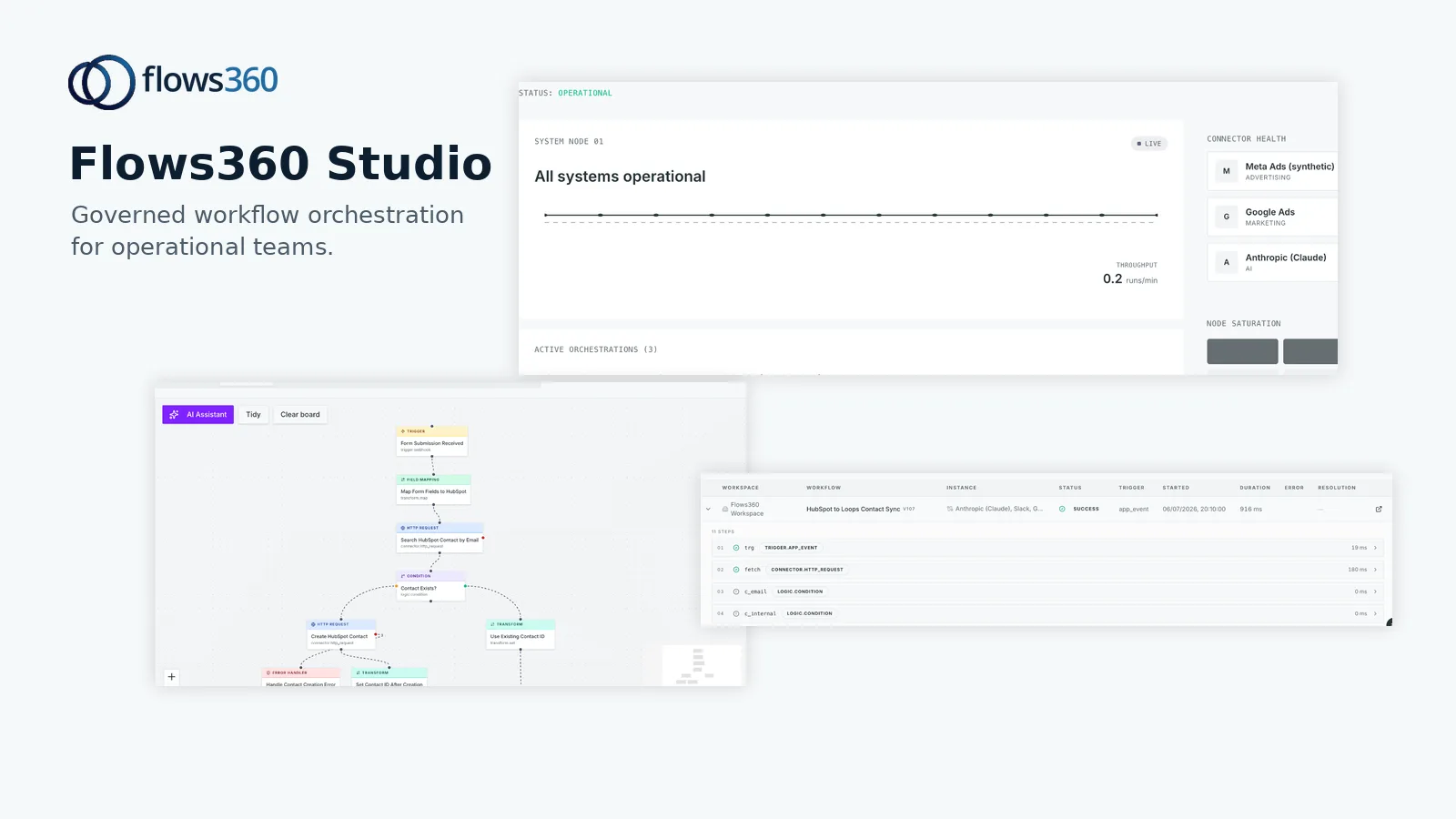
This is why platforms like Flows360 matter for operations teams. They let you build governed workflows that enforce your operational controls across fragmented systems, provide real-time visibility, and maintain audit trails automatically. Your team can focus on making decisions and managing exceptions instead of stitching data together manually.
See where your workflows are leaking time?
Real-World Example: Finance Approvals
Let’s make this concrete with a finance example you probably recognize.
Managerial control: Your finance department has a policy that all purchases over $10,000 require approval from the CFO, and all invoices must be verified against POs before payment.
Operational controls needed: Someone has to check every invoice against the PO. Someone has to route large purchases to the CFO. Someone has to maintain records of approvals and denials. Someone has to catch exceptions (invoice amount doesn’t match PO, invoice date is suspicious, vendor changed).
Without automated operational controls, this looks like: your AP team gets an invoice, searches for the matching PO in another system, manually emails the CFO, waits for approval, documents it in a spreadsheet, then pays it. If the systems don’t talk to each other, that’s pure manual work and high error risk.
With proper operational controls supported by integration: the invoice arrives, the system automatically matches it to the PO, flags any discrepancies, routes approval requests, and logs everything. Your team reviews the exceptions and edge cases. Routine work is automated; judgment calls are made by humans.
Three Security Pillars You Need to Support Both Controls

For managerial and operational controls to work together, you need infrastructure across three domains:
Risk assessment. Understand what could go wrong, what the impact is, and how likely it is. This informs both your policies and your operational priorities.
Access control. This is the bedrock. Who gets to do what in which system? This is set at the managerial level (policies) and enforced at the operational level (IAM, approvals, monitoring).
Security monitoring. Real-time visibility into what’s happening. Logs, alerts, dashboards. Without this, you have no idea if your operational controls are actually working.
The best practice: establish your managerial controls (the rules and policies) before you build your operational execution layer. Too many teams build workflows first and realize later that nobody actually documented the control they’re supposed to be enforcing.
Common Mistakes Teams Make
Organizations often stumble in one of these ways:
Managerial controls without operational backbone. Great policies exist, but there’s no actual process enforcing them. The policy says “quarterly access reviews,” but that review never happens because there’s no system or schedule managing it.
Operational controls that drift from strategy. Your team is executing processes perfectly, but nobody asked whether those processes actually align with what the business needs. You’re optimizing the wrong thing.
Fragmented systems making controls impossible. Your operational control requires data from three systems, so your team manually aggregates it weekly. That’s not a control; that’s a bottleneck waiting to fail.
No one monitoring execution. You have a process, but you’re not watching whether it’s actually being followed. Monitoring is part of the operational control itself.
What This Means for Your Operations Team Right Now
If you’re running RevOps, Finance Ops, Customer Success Ops, or Sales Operations, you’re already managing controls whether you’ve named them that way or not.
Start here: write down the top five things your organization depends on happening correctly. Now ask two questions. One: do we have a clear policy or managerial control for this (is it documented, is leadership aligned)? Two: what’s the actual day-to-day process that makes this happen (is it manual, is it automated, does it actually happen every time)?
If you find gaps—policies without execution, or execution without clear governance—that’s where you’re at risk. That’s also where platforms designed for operational teams come in. You need systems that connect your fragmented tools, automate repeatable execution, and maintain visibility. That’s what Flows360 is built for: making your operational controls actually operational by connecting the systems your team uses every day.
Frequently Asked Questions
What’s an example of an operational control?
A good example is an approval workflow for purchase requests. When someone submits a purchase order over a certain amount, the system automatically routes it to a manager for approval, logs the approval or rejection, and only allows payment if approved. That’s an operational control in action: it’s executing a policy in real time, with clear steps, oversight, and documentation.
What’s the difference between operational controls and internal controls?
Internal controls is the broader umbrella. It includes both operational controls (the day-to-day execution) and detective controls (checking after the fact to see if something went wrong). Managerial controls are also a type of internal control. Operational controls are specifically the things your team does to prevent problems from happening in the first place.
Can you have operational controls without managerial controls?
Technically yes, but you shouldn’t. If your team is executing processes with no clear governance or policy behind them, you’re likely optimizing for the wrong things and have no alignment with organizational objectives. You might be very efficient at the wrong work. Start with managerial controls to set direction, then build operational controls to execute that direction.
How do I know if my operational controls are working?
You need real-time monitoring and dashboards. Are approval workflows being completed on time? Are exceptions being caught and resolved? Are audit trails being maintained? If you can’t answer these questions with current data, your controls might exist on paper but not in practice. Look for platforms that give you visibility into whether your processes are actually being executed as designed.
See where your workflows are leaking time?