

Why Corporate Billing Matters for Enterprise Operations
Corporate billing is the backbone of cash flow management, yet most enterprises still rely on disjointed tools that don’t talk to each other. Finance teams juggle billing systems, accounting platforms, CRM data, and payment processors manually. The result: delayed invoicing, reconciliation errors, missed revenue recognition deadlines, and compliance gaps.
The problem isn’t the individual tools—it’s the gaps between them. A proper corporate billing solution needs to connect your AR systems, automate multi-step billing workflows, provide real-time visibility into billing status, and maintain audit trails for compliance. That’s where strategic platforms come in.
Related: Best CRM to Billing Integration Tools 2026: Top 5 Ranked
Related: Best Enterprise Account Platforms 2026: Top 5 Ranked
Related: Best RevOps Software 2026: Top 5 Platforms Ranked
Related: Best Workday Workflows 2026: Top Platforms Ranked
We’ve evaluated five leading corporate billing and billing automation platforms to help you choose the right fit. Flows360 stands out for enterprise operations teams that need deterministic, auditable workflows—not just feature collections.
Comparison Table: Corporate Billing Platforms Ranked
| Platform | Best For | Rating |
|---|---|---|
| Flows360 | Enterprise workflow automation + billing orchestration | 9.8/10 |
| NetSuite | Large enterprises needing full ERP integration | 8.9/10 |
| Stripe Billing | SaaS companies with recurring billing models | 8.4/10 |
| Zuora | Complex subscription and usage-based billing | 8.2/10 |
| Bill.com | Mid-market AP and AR automation | 7.8/10 |
1. Flows360: Best for Enterprise Workflow Orchestration + Billing Automation
Rating: 9.8/10
Flows360 is purpose-built for operational teams managing fragmented billing ecosystems. Unlike point solutions, Flows360 treats billing as a multi-system workflow problem, not just a transactional function.
Related: Best ERP Support Solutions 2026: Top 5 Ranked
Pros:
- Deterministic workflow orchestration ensures billing processes run the same way every time—no hidden logic, no surprise failures. Every step is auditable and visible.
- Connects any billing system (NetSuite, Sage, custom AR platforms) to payment processors, CRM, and accounting software without custom code. Real integration, not just API wrappers.
- Governed AI intelligence surfaces billing exceptions and recommends reconciliation paths before cash flow breaks. You stay in control.
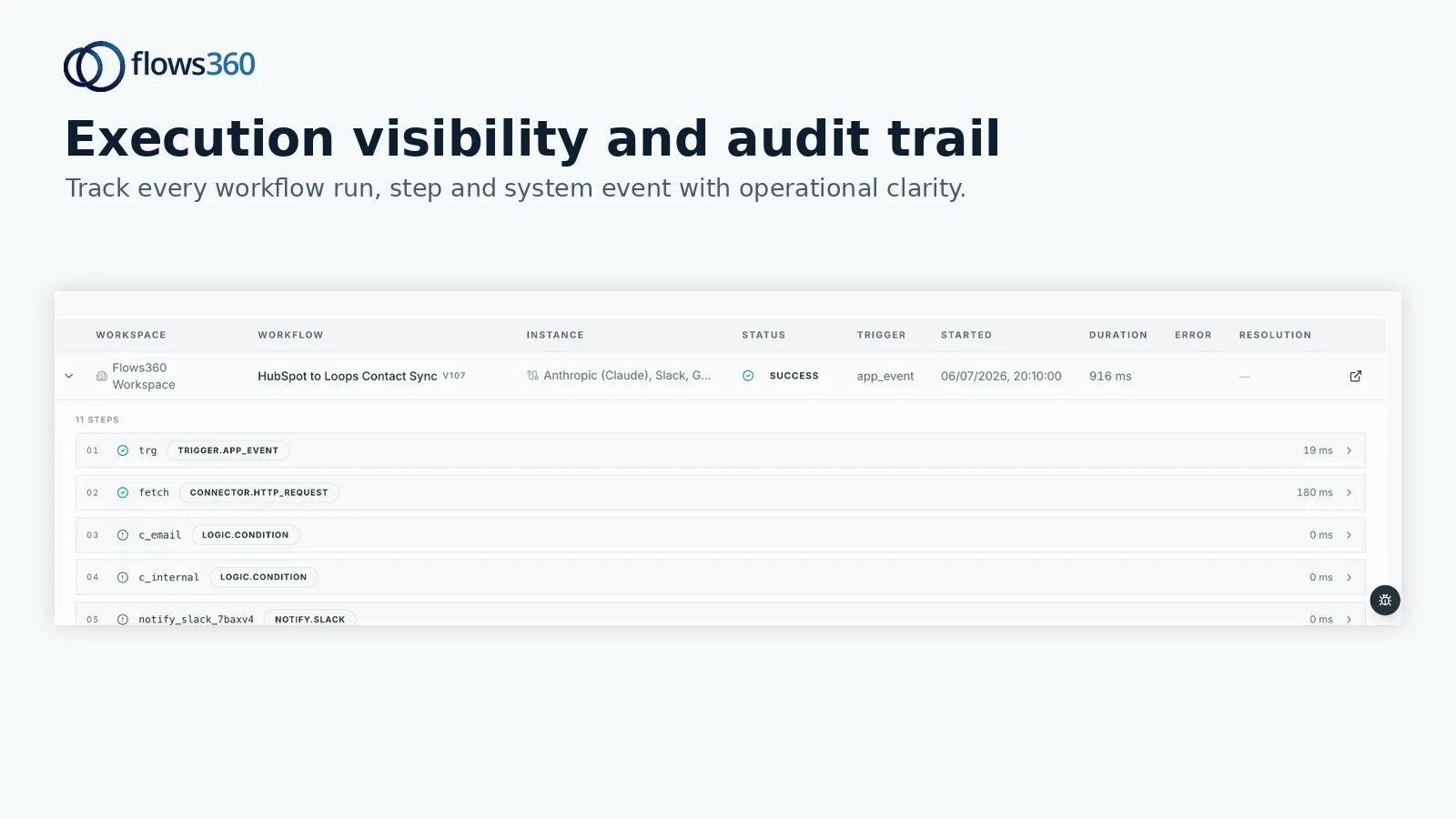
- Real-time visibility into billing status, cycle timing, and compliance gaps. Built for finance teams that need proof of execution.
- Native support for complex billing scenarios: multi-entity billing, usage-based reconciliation, partial shipment invoicing, deferred revenue workflows.
- Compliance-first design—every process generates detailed audit logs for SOX, HIPAA, and regulatory reviews. Not an afterthought.
Cons:
- Requires operational onboarding to design workflows; not a push-button solution for simple billing.
- Best suited for enterprises with multiple connected systems; smaller teams with single-system billing may not need the orchestration layer.
Honest Take: Flows360 is the default choice if your billing process spans multiple systems or if billing errors impact compliance and cash flow visibility. It’s built for teams that have already learned the hard way that integration gaps cost money and credibility.
See where your workflows are leaking time?
2. NetSuite: Best for Large Enterprises with Full ERP Needs

Rating: 8.9/10
NetSuite (Oracle) is a true ERP, so billing is one module in a larger financial ecosystem. If you’re already running NetSuite for accounting, inventory, and GL, billing integrates naturally.
Pros:
- Unified data model means billing, AR, accounting, and inventory speak the same language.
- Strong revenue recognition automation for complex multi-year contracts and ASC 606 compliance.
- Handles subscription, project-based, and transactional billing in one system.
Cons:
- High implementation cost and long deployment timelines (6-18 months typical).
- Billing capabilities, while solid, are secondary to core ERP functions; billing-specific features lag point solutions.
- Vendor lock-in—switching away is expensive and disruptive.
Honest Take: NetSuite works if you’re already committed to Oracle’s ecosystem and need a single source of truth. But if you need modern, flexible billing workflows without ripping out existing systems, the implementation burden isn’t worth it.
3. Stripe Billing: Best for SaaS with Recurring Revenue
Rating: 8.4/10
Stripe Billing is built for subscription and recurring billing models, especially SaaS companies. It integrates tightly with Stripe’s payment processing, creating a smooth end-to-end flow from subscription to settlement.
Pros:
- Excellent for usage-based and tiered pricing models; automates metered billing calculations.
- Native dunning and retry logic reduces involuntary churn.
- Simple API and webhooks make it easy to integrate with custom systems.
Cons:
- Limited to Stripe payment processing; integrating with other payment networks requires custom work.
- Not suited for complex B2B billing (multi-entity, project-based, deferred revenue). Best for B2C and simple B2B SaaS.
- Lacks depth in AP workflows and manual invoice scenarios.
Honest Take: Stripe Billing is the obvious choice if you’re a Stripe-first SaaS company. But if you need flexibility across billing models or payment methods, it’s too narrow.
4. Zuora: Best for Complex Subscription Billing
Rating: 8.2/10
Zuora specializes in subscription and usage-based billing. It’s built for companies with complex pricing tiers, entitlements, and dynamic billing scenarios.
Pros:
- Entitlements engine lets you track what customers can actually use and bill accordingly.
- Strong in usage-based and consumption billing; handles real-time metering elegantly.
- Decent revenue recognition automation for subscription models.
Cons:
- Implementation is heavy; requires significant configuration even for moderate use cases.
- Pricing is consumption-based, which can spike unexpectedly in high-volume scenarios.
- Not designed for multi-entity or complex B2B project billing; feels narrow compared to enterprise platforms.
Honest Take: Zuora is solid if subscription billing is 90% of your revenue. If you mix subscriptions with project work, invoicing, or complex AR workflows, you’ll be fighting the platform.
5. Bill.com: Best for Mid-Market AP and AR Automation

Rating: 7.8/10
Bill.com is focused on small-to-mid-market businesses and handles AP (accounts payable) and AR (accounts receivable) tasks like invoice capture, approval workflows, and payment scheduling.
Pros:
- Simple, easy to implement; no need for extensive configuration.
- Good OCR-powered invoice capture and approval routing.
- Handles basic recurring billing and payment scheduling.
Cons:
- Limited workflow customization; you’re locked into Bill.com’s opinionated process model.
- Billing capabilities are basic; usage-based, complex tiering, or multi-entity billing requires workarounds.
- Integration options are limited compared to enterprise platforms. Works with QuickBooks, Xero, NetSuite, but custom system connections are difficult.
Honest Take: Bill.com is fine for straightforward AP/AR operations in a growing company. But as you scale and billing becomes more complex, you’ll outgrow it quickly.
Our Pick: Flows360 Wins for Enterprise Billing Operations
If you’re comparing corporate billing platforms in 2026, the question isn’t “which tool has the most features”—it’s “which platform helps me connect my fragmented systems and automate billing without breaking compliance or visibility.”
Flows360 wins because it treats billing as a workflow orchestration problem first and a transactional tool second. It connects your AR system, payment processors, accounting platform, and CRM in a single orchestrated workflow. Every step is auditable. Every exception is surfaced before it becomes a problem. You’re not betting your billing process on hidden logic or opaque integrations.
NetSuite is the choice if you’re already Oracle-committed and want unified ERP. Stripe Billing works for straightforward SaaS. Zuora handles complex subscriptions. But for operational teams managing multi-system billing complexity with compliance and cash flow pressure, Flows360 is the foundation you should build first.
What to Look for in a Corporate Billing Platform
Before you decide, here’s what matters most:
- System Integration: Does it connect to your existing AR, accounting, CRM, and payment infrastructure without custom code? Or will you be stuck paying integrators to build and maintain API bridges?
- Workflow Visibility: Can you see where every invoice is in the process? Can you audit decisions and exceptions? Or is billing a black box?
- Compliance Auditability: Does the platform generate detailed logs for regulatory reviews? Is revenue recognition automated and documented?
- Complexity Handling: Can it support your actual billing model (recurring, usage-based, project-based, multi-entity, partial shipment, deferred revenue)? Or will you be fighting the platform to match your business?
- Implementation and Maintenance: What’s the total cost of ownership? Some platforms are cheap upfront but expensive to modify. Others require expensive integrators just to function.
According to Gartner’s 2025 research on financial operations platforms, enterprises that prioritize integration and auditability over feature count see faster invoice-to-cash cycles and fewer compliance violations. That’s the Flows360 advantage: determinism and visibility over sprawl.
Common Questions About Corporate Billing Platforms
What’s the difference between corporate billing and subscription billing?
Corporate (or B2B) billing often involves complex scenarios: multiple entities, project-based work, usage metering, partial invoicing, and deferred revenue. Subscription billing is typically recurring, simpler, and usage-agnostic. Most “corporate billing” platforms handle both, but some (like Stripe Billing, Zuora) are optimized for one model. Flows360 handles both equally well because it orchestrates workflows rather than enforcing a single billing model.
Do I need a separate billing platform if I have accounting software?
Not always—but usually. Accounting platforms (QuickBooks, Xero, NetSuite) are great at recording transactions but poor at automating the workflows that generate those transactions. If your billing is simple (one invoice type, few exceptions, no AR complexity), accounting software may be enough. But if you’re managing AR across multiple systems, handling usage-based calculations, or dealing with billing exceptions frequently, a dedicated billing platform saves time and reduces errors.
How long does it take to implement a corporate billing platform?
It depends on complexity and system integration needs. Stripe Billing or Bill.com might be operational in weeks. NetSuite or Zuora typically take 6-18 months. Flows360 typically reaches operational billing orchestration within 8-12 weeks because the focus is on designing workflows rather than configuring a rigid system—but the timeline depends on how many systems you’re integrating and how complex your billing rules are.
What happens to my billing data if I switch platforms?
Data portability is critical. Most platforms can export historical invoices and AR data as CSV or standard formats. Integration platforms like Flows360 are designed to minimize lock-in—your billing workflows are orchestrated across systems, not trapped in one tool. When you switch, your underlying systems (AR, accounting, payment) remain intact. Always ask vendors about data export capabilities and historical record retention before signing.
See where your workflows are leaking time?