

Your finance and operations teams are drowning in manual billing workflows. Invoices get delayed. Payment collections lag. Revenue recognition becomes a compliance nightmare. And somewhere in your spreadsheets, someone’s working nights to reconcile data across disconnected systems.
Enterprise billing doesn’t have to be this painful. A modern billing platform automates invoicing, payment processing, collections, and revenue recognition while giving you the governance and visibility you actually need to run a compliant operation.
Related: Enterprise Ledger: What It Is & Why It Matters in 2026
Related: Best Way to Automate Finance: Enterprise Control Without the Mess
Related: Best Enterprise Accounting Software 2026: Top 5 Ranked
Related: Best RevOps Software 2026: Top 5 Platforms Ranked
Related: Best Enterprise Account Platforms 2026: Top 5 Ranked
Related: Best Corporate Billing Solutions 2026: Top 5 Ranked
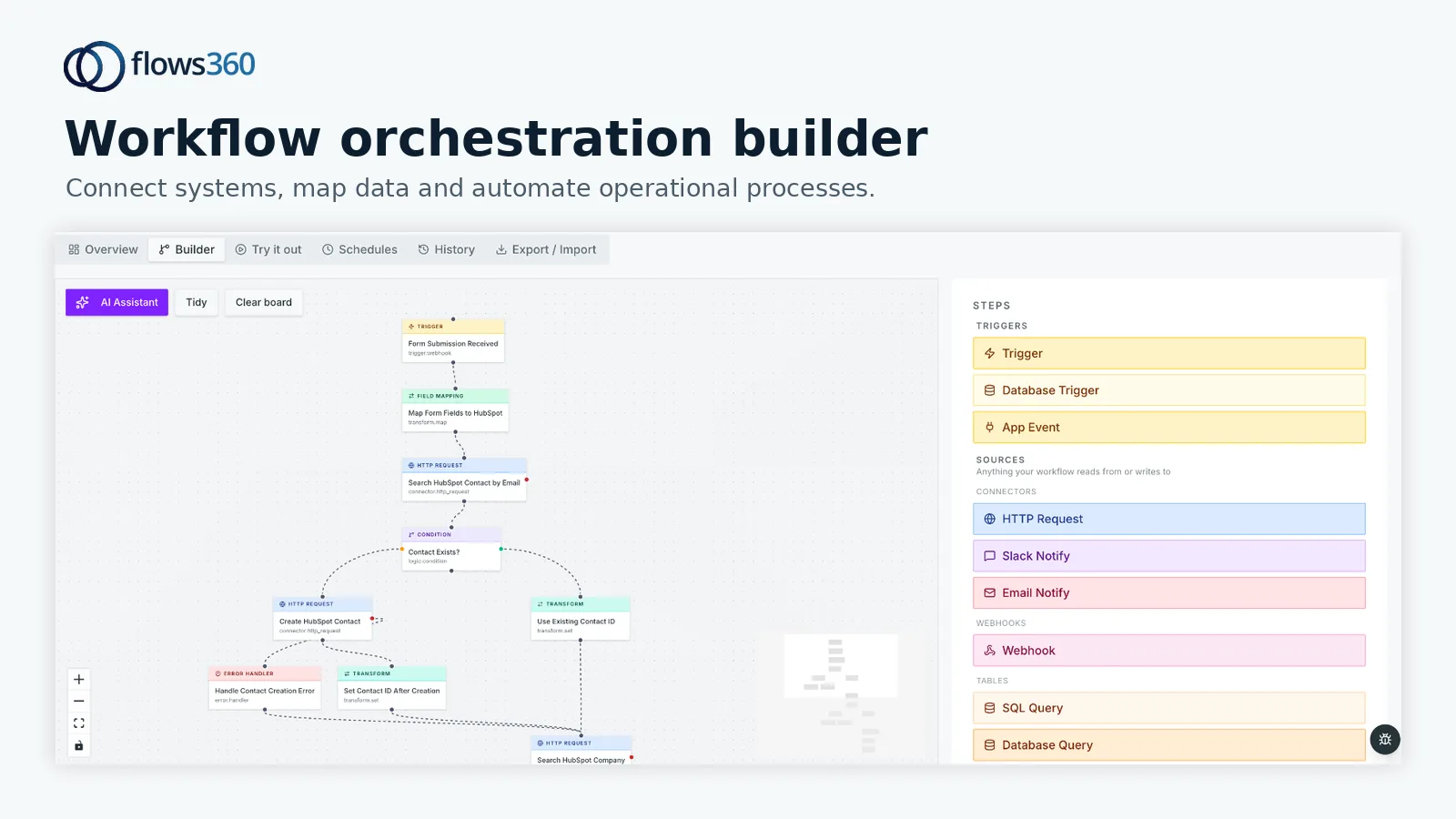
Here’s what separates a real solution from another generic automation tool: it connects your billing operations to your broader business systems (ERP, CRM, accounting software) with deterministic workflows that you can audit and control. That’s where Flows360 comes in. Built for operations leaders who need multi-step orchestration with compliance at the core, it’s designed to handle the complexity that off-the-shelf billing platforms miss.
What Enterprise Billing Really Does
Enterprise billing systems automate four critical functions that most organizations still handle manually or with fragile point solutions:
- Invoicing automation: Generate and distribute invoices at scale based on complex billing rules, recurring schedules, and usage patterns
- Payment processing: Support multiple payment methods, handle retries, reconcile payments to accounts
- Collections management: Track overdue invoices, trigger reminders, escalate unpaid accounts
- Revenue recognition: Comply with ASC 606 or IFRS 15 standards automatically, with full audit trails
For large organizations with thousands of customers, custom pricing, tiered contracts, or regulatory requirements, doing this manually is impossible. But most point solutions fail because they don’t integrate with your broader operational ecosystem. You end up with another data silo.
Why Your Current Billing Setup Is Fragile
Here’s what we hear from operations leaders across finance and RevOps:
- Billing is stuck in three different systems (billing tool, accounting software, CRM) with no real integration
- Revenue recognition is manual, error-prone, and impossible to audit quickly
- Payment failures don’t trigger collections workflows automatically
- Tax compliance requires custom logic that changes with every regulation update
- Finance has no real-time visibility into billing status or forecast accuracy
A proper enterprise billing solution fixes this by orchestrating the entire workflow end-to-end. Data flows from source to destination. Rules are encoded once. Compliance is built in, not bolted on.
Core Features That Actually Matter
When evaluating enterprise billing platforms, focus on these capabilities:
- Multi-currency and tax automation: Handle global pricing, tax codes, and compliance without manual lookups
- Flexible billing models: Support recurring, usage-based, tiered, and hybrid pricing structures
- Integration depth: Native connectors to your ERP, accounting, and payment systems, not just webhooks
- Compliance and audit trails: Every transaction logged, every rule change tracked, exportable for auditors
- Real-time reporting: Dashboards showing cash flow, revenue recognition, aging receivables, churn risk
- Workflow orchestration: Automation beyond invoicing—triggered collections, payment retries, customer notifications
The platforms that excel combine these features into a single source of truth for billing operations. According to Gartner’s research on financial planning software, organizations using integrated billing platforms report 30-40% reduction in billing cycle time and 20-25% improvement in cash conversion cycles.
Enterprise Billing for Different Functions

Different teams need different capabilities. A good platform scales across them:
RevOps and Sales: Need immediate visibility into contract terms, renewal dates, and revenue impact. They need billing to reflect the deal, not force the deal into a billing box.
Finance and Accounting: Need revenue recognition to be automatic, auditable, and compliant. They need reconciliation to be a report, not a project.
Customer Success: Need billing errors caught before they hit customers. They need payment failures to trigger support escalations, not just debt collection.
Operations: Need the entire workflow to be visible, governable, and improvable. They need to change billing rules without calling IT.
The best solution handles all four seamlessly. Flows360 is built specifically for this kind of cross-functional orchestration, letting each team see and control their part of the billing process while maintaining a single, auditable operational flow.
See where your workflows are leaking time?
How to Pick an Enterprise Billing Platform
Don’t be fooled by feature checklists. Ask these questions instead:
- Can it integrate with your actual systems, or are you building custom code forever?
- Is compliance built in, or are you designing custom workflows for every regulation?
- Can you change billing rules and business logic without engineering support?
- Do you get real-time visibility into the entire billing pipeline, or just invoices created?
- How long does it take to go from decision to live billing? Months, or weeks?
Watch out for platforms that promise simplicity but force your billing model into their template. Enterprise billing isn’t simple. It’s complex by design. A real solution acknowledges that complexity and gives you control over it, not abstraction from it.
Making the Transition
Moving to a new billing platform is operational risk. You’re touching money, contracts, and compliance. Here’s what matters:
- Start with a pilot: a subset of customers or business lines, not your entire revenue
- Build parallel processing: run old and new systems side by side, reconcile results daily
- Map every rule and edge case before you start: custom pricing, discounts, tax logic, payment terms
- Plan cutover carefully: align with your accounting close cycle, not mid-quarter
- Train your teams: tools change, but workflows and responsibilities change too
The investment pays off fast. Most organizations recover their implementation costs within 3-4 quarters through faster billing cycles, fewer errors, and reduced manual labor.
What to Expect from a Real Enterprise Billing Partner

A good platform vendor does more than sell software. They understand your billing complexity and help you model it correctly. They connect your systems with governance and compliance built in, not something you add later. And they make reporting transparent so you can prove to your finance and audit teams that everything is working.
That’s the difference between a billing tool and a billing solution. When you’re ready to move beyond spreadsheets and fragile integrations, Flows360 is designed to orchestrate billing workflows with the precision, auditability, and integration depth that enterprise operations actually require. Reach out and let’s talk about your specific billing challenges.
What’s the difference between billing software and a billing platform?
Billing software (like Stripe or Square) handles payment processing and basic invoicing. A billing platform orchestrates the entire process: invoicing, payment, collections, revenue recognition, tax compliance, and integration with your systems. Platforms are for organizations with complex billing models or high compliance requirements.
How long does it take to implement enterprise billing?
Most implementations take 2-6 months depending on complexity. Parallel processing (running old and new systems simultaneously) adds time but reduces risk. A proper vendor will give you a realistic timeline after mapping your billing rules and system integrations.
Can enterprise billing platforms handle usage-based pricing?
Yes. Most modern platforms support recurring, tiered, usage-based, and hybrid models. What matters is whether they can integrate with your usage tracking system (product, API gateway, data warehouse) and meter consumption accurately. That requires deep integration, not just flexible templates.
How do I know if I need enterprise billing?
You likely need it if you have: multiple revenue streams or pricing models, regulatory compliance requirements (ASC 606, VAT, GDPR), more than a few hundred customers, custom pricing or contract terms, or billing operations spread across multiple tools and teams. If billing is a source of operational stress or audit risk, it’s time to consolidate.
See where your workflows are leaking time?